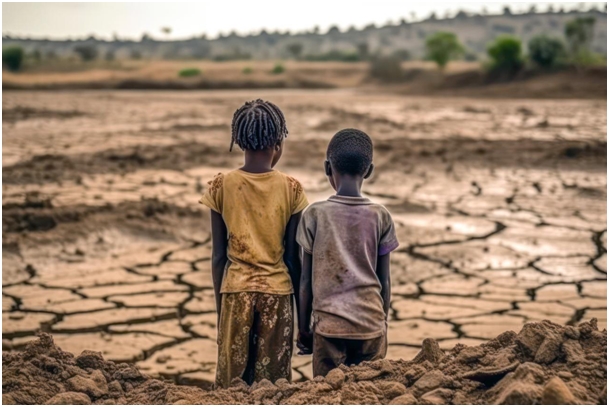
For the past four years, the World Meteorological Organization (WMO) has published its annual report on the state of the climate in Africa. Global warming is nothing new, but in 2024, the tone was more serious than ever in this highly alarming report: the African continent is sinking, both climatically and economically, and the repercussions of the ongoing disaster will extend far beyond its borders.
The year 2023 has already been marked by temperatures well above normal in Africa: +0.61°C above the average for the last 30 years and +1.28°C above the average for 1961-1990. In Mali, Morocco, Uganda, and Tanzania, 2023 was the hottest year on record. The African continent is warming by +0.3°C every decade, which is faster than the global average. Heat waves classified as “extreme” by the World Meteorological Organization (WMO) are increasing every summer, particularly in North Africa, such as in Tunisia and Morocco. These two countries have also broken new records for maximum temperatures: 49°C in Tunis, Tunisia, and 50.4°C in Agadir, Morocco.
Sea levels are also rising faster in Africa than the global average: +3.4 millimeters per year and up to 4.1 millimeters per year along the Red Sea.
The consequences of these extreme weather conditions will be visible during this decade, with thousands of deaths, millions of migrants, and billions of dollars needed to remedy these extreme weather events.
The consequences of all these climate changes are human, but also economic. In 2023, rainfall reached extremes: floods killed at least 700 people in Libya (linked to Cyclone Daniel) and drought devastated crops in North Africa, among other places. In Tunisia, cereal production fell by 80% due to persistent drought. In Niger, Benin, and Ghana, agriculture partially collapsed due to water shortages.
Weather disasters also cause huge population displacements, exacerbating conflicts in already unstable areas: the historic floods that affected Ethiopia, Somalia, and Kenya killed at least 350 people (a figure that is likely to be significantly underestimated due to the lack of information on the ground) and caused the migration of 2.4 million people in just three months (April, May, and June 2023).
The WMO estimates that African countries lose an average of 2 to 5% of their GDP (gross domestic product) due to climate disasters, and some spend 9% of their budget on them. Africa has no choice but to adapt to these extreme weather events, but this will come at a huge cost: $30 to $50 billion per year is needed, or 2 to 3% of GDP. If strong measures are not put in place now, the situation will become unliveable by 2030 for 118 million people due to extreme heat, drought, and flooding.
What are the solutions? According to the WMO, the priority is to develop weather and hydrological services (which are non-existent in some countries) and early warning systems to better anticipate disasters, while continuing to implement more sustainable development practices, such as better water resource management, preserving the environment and vegetation cover. In certain regions, particularly in North Africa and the Sahel, trees need to be planted on a massive scale.
In summary, the consequences of climate change are having a significant impact on the African continent. With temperatures in Africa rising slightly above the global average.
Multi-year droughts, which are likely to persist in northwestern Africa in the coming years
Extreme flooding, which will cause significant losses and damage. The cost of climate change is therefore likely to increase for African countries. It is necessary to invest in early warning systems to protect lives and economies