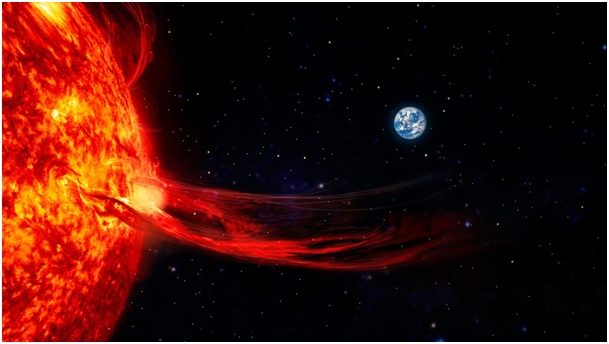
Since 2008, in-orbit instruments have revealed a gradual but steady change in the Sun’s behavior. While models predicted a long period of calm, data collected by NASA missions have shown a clear reversal of this trend. Solar activity—measured by the intensity of the solar wind, particle temperature, and the strength of the interplanetary magnetic field—is on the rise again. This reversal is causing concern among experts, as it could signal several decades of intense solar storms, which could affect our satellites, power grids, and navigation systems. The analysis, conducted by a team at the Jet Propulsion Laboratory (JPL), a NASA division in California, was published on September 8, 2025, in « The Astrophysical Journal Letters »[1]. It is based on data from several space probes, including ACE and Wind, which have been active since the late 1990s.
For nearly three decades, signals from the Sun seemed to point to the same conclusion: our star was heading toward a long period of calm, comparable to the one observed between 1645 and 1715, known as the Maunder Minimum. This hypothesis was based on consistent indicators, including a gradual decline in the number of sunspots and a weakening of the solar wind. In 2008, this trend reached a historic low. All measured parameters—thermal pressure, plasma density, and magnetic field strength—showed values never before recorded since the beginning of modern monitoring. But since then, data from NASA’s ACE (Advanced Composition Explorer) and Wind satellites have revealed a gradual shift. Researchers at the Jet Propulsion Laboratory (JPL)[2] coordinated an in-depth analysis of this data. They confirm that all indicators are on the rise again. The solar wind’s speed has increased by 6 percent, its density by 26 percent, and its temperature by 29 percent. The strength of the interplanetary magnetic field has increased by 31 percent.
This unexpected development calls into question the scenario of a modern « grand minimum. »[3]. The Sun is emerging from a nearly 20-year cycle of decline. This gradual reawakening is already accompanied by a resurgence of visible manifestations of solar activity, such as sunspots, flares, and coronal mass ejections. The predicted lull appears to have given way to a sustained recovery. These solar cycles, whose complexity is still poorly understood, pose a threat: that of a global Internet outage. It would not be caused by a computer virus or a cyberattack, but by a disruption triggered by an extreme solar storm.
——————————-
[1] « The Sun Reversed Its Decades-long Weakening Trend in 2008 » Jamie M. Jasinski and Marco Velli. Published 2025 September 8 • © 2025. The Author(s). Published by the American Astronomical Society. The Astrophysical Journal Letters, Volume 990, Number 2 – Citation Jamie M. Jasinski and Marco Velli 2025 ApJL 990 L55DOI 10.3847/2041-8213/adf3a6. https://iopscience.iop.org/article/10.3847/2041-8213/adf3a6
[2] NASA/JPL, « NASA Analysis Shows Sun’s Activity Ramping Up », 15 septembre 2025, https://www.jpl.nasa.gov/news/nasa-analysis-shows-suns-activity-ramping-up/
Jasinski, J. M., & Velli, M. (2025). « The Sun Reversed Its Decades-Long Weakening Trend in 2008. » The Astrophysical Journal Letters, 989(2), L18. https://doi.org/10.3847/2041-8213/adf3a6
[3] NASA Analysis Shows Sun’s Activity Ramping Up – Sept. 15, 2025- https://www.jpl.nasa.gov/news/nasa-analysis-shows-suns-activity-ramping-up/
Read more on December 1st, 2026