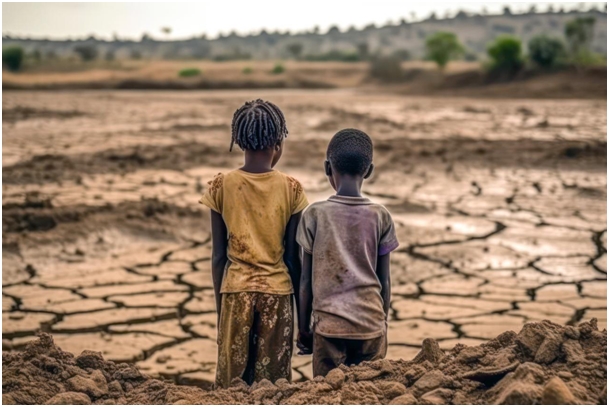
For the past four years, the World Meteorological Organization (WMO) has published its annual report on the state of the climate in Africa. Global warming is nothing new, but in 2024, the tone was more serious than ever in this highly alarming report: the African continent is sinking, both climatically and economically, and the repercussions of the ongoing disaster will extend far beyond its borders. The year 2023 has already been marked by temperatures well above normal in Africa: +0.61°C above the average for the last 30 years and +1.28°C above the average for 1961-1990. In Mali, Morocco, Uganda, and Tanzania, 2023 was the hottest year on record. The African continent is warming by +0.3°C every decade, which is faster than the global average. Heat waves classified as “extreme” by the World Meteorological Organization (WMO) are increasing every summer, particularly in North Africa, such as in Tunisia and Morocco. These two countries have also broken new records for maximum temperatures: 49°C in Tunis, Tunisia, and 50.4°C in Agadir, Morocco.
Sea levels are also rising faster in Africa than the global average: +3.4 millimeters per year and up to 4.1 millimeters per year along the Red Sea. The consequences of these extreme weather conditions will be visible during this decade, with thousands of deaths, millions of migrants, and billions of dollars needed to remedy these extreme weather events. The consequences of all these climate changes are human, but also economic. In 2023, rainfall reached extremes: floods killed at least 700 people in Libya (linked to Cyclone Daniel) and drought devastated crops in North Africa, among other places. In Tunisia, cereal production fell by 80% due to persistent drought. In Niger, Benin, and Ghana, agriculture partially collapsed due to water shortages.
Weather disasters also cause huge population displacements, exacerbating conflicts in already unstable areas: the historic floods that affected Ethiopia, Somalia, and Kenya killed at least 350 people (a figure that is likely to be significantly underestimated due to the lack of information on the ground) and caused the migration of 2.4 million people in just three months (April, May, and June 2023). The WMO estimates that African countries lose an average of 2 to 5% of their GDP (gross domestic product) due to climate disasters, and some spend 9% of their budget on them. Africa has no choice but to adapt to these extreme weather events, but this will come at a huge cost: $30 to $50 billion per year is needed, or 2 to 3% of GDP. If strong measures are not put in place now, the situation will become unliveable by 2030 for 118 million people due to extreme heat, drought, and flooding.
What are the solutions? According to the WMO, the priority is to develop weather and hydrological services (which are non-existent in some countries) and early warning systems to better anticipate disasters, while continuing to implement more sustainable development practices, such as better water resource management, preserving the environment and vegetation cover. In certain regions, particularly in North Africa and the Sahel, trees need to be planted on a massive scale. In summary, the consequences of climate change are having a significant impact on the African continent. With temperatures in Africa rising slightly above the global average. Multi-year droughts, which are likely to persist in northwestern Africa in the coming years Extreme flooding, which will cause significant losses and damage. The cost of climate change is therefore likely to increase for African countries. It is necessary to invest in early warning systems to protect lives and economies
The WMO estimates that African countries lose an average of 2 to 5% of their GDP (gross domestic product) due to climate-related disasters, and some spend as much as 9% of their budgets on disaster response. Africa has no choice but to adapt to these weather extremes, but this will come at a huge cost: $30 to $50 billion per year is needed, or 2 to 3% of GDP. If strong measures are not implemented immediately, the situation will become unlivable by 2030 for 118 million people due to extreme heat, drought, and flooding. Without adequate measures, up to 118 million people living in extreme poverty (on less than $1.90 per day) could be exposed to drought, flooding, and extreme heat in Africa by 2030. According to the figures presented in this report, this situation will place an additional burden on poverty reduction efforts and significantly slow growth.
African countries must prioritize increased investment in National Meteorological and Hydrological Services (NMHS) and accelerate the implementation of the “Early Warning for All”[2] Initiative to save lives and livelihoods. According to the report, such an approach will help mitigate risks, strengthen adaptive capacities, increase resilience at the local, national, and regional levels, and guide sustainable development strategies. This report focuses on the indicators and impacts of climate change in 2023, the hottest year on record globally. It complements the WMO’s State of the Global Climate report and is part of a series of regional reports by the organization designed to disseminate observational data that guides initiatives and supports decision-making. Over the past 60 years, Africa has warmed faster than the rest of the world. In 2023, the continent endured deadly heatwaves, heavy rains, floods, tropical cyclones, and prolonged droughts.
In 2023, while many countries in the Horn of Africa, Southern Africa, and Northwest Africa continued to suffer from exceptional multi-year drought, other countries experienced episodes of extreme rainfall, which caused floods resulting in numerous casualties. These extreme events had devastating effects on populations and serious economic consequences. This situation continued into 2024 and 2025. Parts of Southern Africa were hit by a devastating drought. Exceptional seasonal rainfall brought death and destruction to countries in East Africa, most recently in Sudan and South Sudan. An already desperate humanitarian crisis was thus exacerbated.
The African continent has warmed at a slightly faster rate than the global average—about +0.3 °C per decade between 1991 and 2023. Of all Africa’s subregions, North Africa has warmed the fastest, with an average increase of about 0.4 °C per decade between 1991 and 2023, compared to 0.2 °C per decade between 1961 and 1990, and Southern Africa has experienced the slowest warming, with an average increase of about 0.2 °C per decade between 1991 and 2023. In 2023, the most significant positive temperature anomalies were recorded in Northwest Africa, particularly in Morocco, the coastal areas of Mauritania, and northwestern Algeria. Several countries, including Mali, Morocco, the United Republic of Tanzania, and Uganda, experienced their hottest year on record. In July and August, North Africa was hit by extreme heat waves. A record high of 49.0°C was set in Tunis, the capital of Tunisia, and a new maximum temperature of 50.4°C was recorded in Agadir, Morocco. Regions experiencing a significant rainfall deficit include western North Africa, the Horn of Africa, and parts of Southern Africa, notably Zambia, Zimbabwe, Botswana, and most of Namibia. In addition, Madagascar, central Sudan, northern Ethiopia, and Uganda have experienced below-normal rainfall.
In West Africa, the onset of the monsoon rainy season was normal to early. Precipitation was significantly above normal in Angola and in coastal areas north of the Gulf of Guinea. Regarding sea level rise: The rate of sea level rise around the continent was close to or slightly above the global average of 3.4 mm per year. The Red Sea recorded the highest rate: 4.1 mm per year. Extreme weather events, particularly floods and droughts, have had a major impact on food security.
In 2023, North Africa’s cereal production was approximately 10% below the five-year average. It was estimated at 33 million tons, which is similar to the previous year’s harvest, already reduced by drought. Tunisia saw the sharpest decline. Irregular rainfall and the general security situation kept cereal production below average in the northern parts of the subregion, particularly in Sudan, South Sudan, the Karamoja region (Uganda), Eritrea, Ethiopia, and central and western Kenya. In Sudan, seasonal rains were below average and irregularly timed, with prolonged periods of drought. Sorghum and millet production is expected to be about 25% and 50% lower, respectively, than in 2022.
Climate-resilient development in Africa requires investment in hydrometeorological infrastructure and early warning systems to prepare for the increasing severity of high-impact hazardous events. Investment in African hydrometeorological services is necessary to improve data collection and forecasting capabilities, thereby strengthening these institutions’ ability to issue early warnings and bulletins in the event of extreme events. In particular, investment in cutting-edge technologies and systems is needed to improve the accuracy and timeliness of meteorological, climate, and hydrological forecasts. An ambitious action plan to provide early warnings for all in Africa was launched in September 2023. Its primary goal is to ensure that all segments of African society, particularly the most vulnerable, receive accurate and timely information about natural hazards and impending disasters. This plan responds to the call issued by UN Secretary-General António Guterres for every person on the planet to be protected by early warning systems by 2027. Several African countries have been selected to receive priority support under this global initiative.
Between 1970 and 2021, 35% of weather-, climate, and water-related deaths occurred in Africa. Yet only 40% of the African population has access to early warning systems. This is the lowest proportion of any region in the world. The new action plan for early warnings for all in Africa aims to change this situation. Weather phenomena and conditions linked to climate change place a disproportionate burden and risk on Africa. They trigger massive humanitarian crises that undermine agriculture and food security, education, energy, infrastructure, peace and security, public health, water resources, and socioeconomic development as a whole.
——————————————-
[1] World Meteorological Organization – (WMO) – State of the Climate in Africa 2023. Published 02 September 2024. https://wmo.int/resources/publication-series/state-of-climate-africa/state-of-climate-africa-2023
[2] The Early Warnings for All (EW4All) initiative aims to ensure universal protection from hazardous hydrometeorological, climatological and related environmental events through life-saving multi-hazard early warning systems, anticipatory action and resilience efforts by the end of 2027, as called for by the United Nations Secretary-General António Guterres in 2022. https://earlywarningsforall.org/site/early-warnings-all