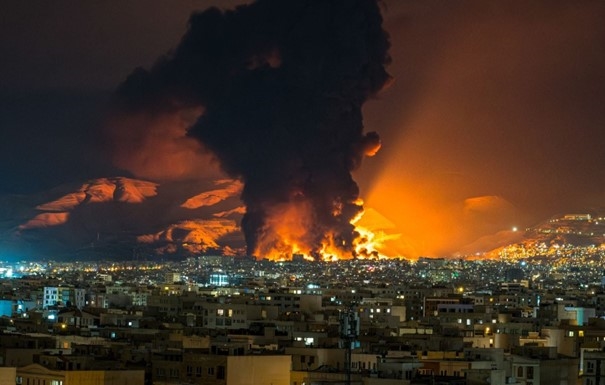
The upheaval in the Middle East since Saturday, February 28, has become the “Fourth Gulf War,” following the Iran-Iraq War (1980–1988), the Gulf War (1990–1991), and the U.S. invasion of Iraq (2003). This time, the U.S.-Israeli coalition has as its “willing allies” the Arab states, all of which host bases in the Middle East.
Even though, at the time of writing, there is no longer any talk of regime change in Iran, the precision of the decapitation strikes, as well as the scale and repetition of the blows dealt to the Iranian military apparatus, have been particularly massive and impressive.
The illegal war launched by the United States and Israel against Iran, during the month of Ramadan and in the midst of diplomatic negotiations in the Sultanate of Oman, raises obvious issues under international law. This war thus began with massive bombings and the targeted assassination of Supreme Leader Ali Khamenei on February 28, 2026.
A few days later, Ali Larijani, head of the Supreme National Security Council and the most prominent political figure since the death of Ali Khamenei, was killed on the night of Monday, March 16, in an Israeli airstrike on the house in the Iranian capital where he had taken refuge with his son.
Since late February 2026, the confrontation between the Israeli-American coalition and Iran has crossed a threshold that two decades of intermittent escalation had hinted at without ever materializing: that of a direct, open war involving simultaneous massive bombings and mirror-image retaliations. Joint U.S. and Israeli operations against Iranian military and nuclear facilities triggered an immediate reaction from Tehran in the form of ballistic missile and drone strikes targeting Israel, U.S. forward bases in the Gulf, and several regional energy infrastructure sites.
The current conflict cannot be understood solely in terms of its immediate protagonists. It marks a deeper transformation in the nature of conflict in the Middle East, one that has gradually taken shape over several decades of wars in Iraq, Palestine, Syria, Lebanon, and Yemen.
Since 2003, regional conflicts have ceased to be structured by traditional interstate wars and have taken the form of hybrid systems involving states, militias, covert operations, and economic warfare.
What the war against Iran, which began on February 28, demonstrates is not the omnipotence of the United States, but rather its most persistent limitation: Americans know how to dismantle a center of power, but are far less capable of establishing the political order that should succeed it. This was, in essence, the lesson already learned from Iraq and Afghanistan.
When this war ends, the most significant change will not be the erosion of Iran’s military capabilities, however significant that may be. It will be the moment when the Gulf states hosting U.S. forces shift from deference to conditionality. This will not be a rupture but an attempt to redefine the terms of the alliance after a war that has highlighted their asymmetries.
In reality, the West has already ceased to rule the world. The problem is that it hasn’t realized it yet! The United States remains the world’s leading military power. But it is no longer the nerve center of the international system. It continues to speak like an empire, but is beginning to act like just one great power among many.
Read more: May 1, 2026