Covering 71% of the Earth’s surface, the seas and oceans are governed by complex relationships between nations. Major maritime explorations laid the foundations for sovereignty at sea, transforming the oceans from open spaces into central arenas of power, trade, and security, shaped by the law of the sea and the rivalry between mare liberum and mare clausum. From Grotius to Selden to the Montego Bay Convention, maritime law has evolved as a fragile compromise between freedom of navigation and functional territorialization, now being tested by the militarization of maritime spaces and fait accompli strategies. The South China Sea, the Arctic, and strategic straits demonstrate that the law now serves as much to legitimize power as to contain conflicts, making the oceans the geopolitical heart of the 21st century. Marco Polo (1254–1324), the famous Italian merchant, and Ibn Battuta (1304–1377) Christopher Columbus, Bartolomeu Dias, Vasco da Gama, Ferdinand Magellan, Francis Drake, Amerigo Vespucci, Jacques Cartier… the great maritime explorers of the 14th and 16th centuries opened up new sea routes and revealed the strategic importance of the seas and oceans.
These explorations were not merely technical feats: they laid the groundwork for maritime sovereignty, enabling states to control and claim maritime spaces to protect their interests—primarily commercial, but also political and geopolitical. At a time when land borders appear fixed on maps, despite ongoing conflicts, it is the oceans that are becoming the new battlegrounds for rivalry. Far from the image of a space that is free and open to all, a mosaic of maritime zones extends where international law, national ambitions, and major strategic issues intertwine. Sovereignty over maritime spaces—from territorial waters to exclusive economic zones (EEZs)—is now redefining the balance of power: Controlling the seas, oceans, and straits means securing vital resources, safeguarding essential trade routes, and asserting one’s expansion and geopolitical influence on the world stage. Today, understanding the historical origins sheds light on current issues surrounding maritime territories, trade, and international security, and may, in turn, help us grasp the geopolitical complexity of regions such as the South China Sea, the Arctic, the Black Sea, the Eastern Mediterranean, and the Baltic Sea. The law of the sea has its origins in international relations, and more specifically in commercial trade conducted via maritime routes. Maritime transport accounts for 80% of the value and 90% of the volume of global trade. The seas and oceans serve as the foundation for all geopolitical relations between states. The first legal text referring to the law of the sea is believed to date back to Emperor Justinian I (483–565). In Roman law, the rule is to consider the seas as common spaces for humanity (communes omnium naturali jure), just like rivers, streams, or the air. These spaces belong to no one, and no one may derive exclusive benefit from them.
In 1493, Pope Alexander VI made the first attempt to regulate sovereignty over the seas in his papal bull “Inter cætera.” This document was published one year after Christopher Columbus’s arrival in the Americas. The Treaty of Tordesillas was signed on June 7, 1494, between the two dominant maritime powers of the time—Spain and Portugal—and established (with the pope’s approval) an imaginary dividing line running from the North Pole to the South Pole, located approximately 370 leagues west of the Cape Verde Islands: to the east of the line, the lands belonged to Portugal (possessions in Africa and Brazil), and to the west of the line, the lands belonged to Spain (Central and South America). This division left its mark culturally and economically until the independence of the states concerned, while nevertheless preserving the linguistic framework. Hugo de Groot, also known as Huig de Groot or Grotius (1583–1645), was a Dutch jurist regarded as the « father of international law. » His major work, « Mare Liberum » (1609), defended the freedom of the seas, opposing the doctrine of exclusive maritime control (particularly by Portugal, Spain, and England). He laid the foundations of modern maritime law by arguing that the sea is an open space for navigation and that this openness is a prerequisite for trade and stability. John Selden (1584–1654), also a jurist, wrote « Mare Clausum » in 1635 in response to Grotius. He argued that certain seas could be under national control, particularly for practical, historical, and commercial reasons. He thus viewed the sea as an extension of land territory and, de facto, a controllable space. Selden regarded the sea as a space of sovereignty. It should be noted that this was a time of fierce competition between the Dutch East India Company, whose original official name was Vereenigde Oostindische Compagnie, and the East India Company, later known as the British East India Company. This controversy remains a particularly illuminating analytical framework for understanding contemporary maritime dynamics.
While international law of the sea has long represented a compromise between these two perspectives, recent developments in naval strategies tend to revive, de facto, a trend toward the closure and gradual territorialization of maritime spaces. Furthermore, this controversy tends to show that contemporary maritime conflicts are not new, but rather a resurgence of past issues, and that it fits into current debates on freedom of navigation, challenges to maritime law, anti-access/area denial (A2/AD) strategies, expanded Exclusive Economic Zones (EEZs), closed seas (Black Sea), and regional lockdown strategies. Today, there is a resurgence of Seldenian practices without any formal challenge to the law, and a return to a functional imperial maritime logic. Selden is not the only one to have opposed Grotius’s theses. William Welwod (1578–c. 1624), a Scottish jurist and theologian, also criticized Grotius, but from a religious and moral perspective, in relation to the rights of Catholic and Protestant nations on the seas; and Serafim de Freitas (1572–1633), a Spanish jurist and Dominican friar, author of « De iusto imperio Lusitanorum asiatico, » defending Portugal’s right to control the sea routes to Asia, based on natural law and divine law. His position is similar to Selden’s regarding the concept of territorial sovereignty, but applied to colonies and distant seas. Through their works, these four authors laid the foundations of modern international law, particularly maritime law and the rules of war at sea.
The 1958 Geneva Convention actually refers to a set of four international conventions adopted in Geneva on April 29, 1958, following the first United Nations Conference on the Law of the Sea: conventions on the territorial sea and the contiguous zone, on the high seas, on the continental shelf, and on fishing and the conservation of living resources of the high seas. Their main objectives are to codify the law of the sea and to clarify the rights and obligations of states regarding maritime areas, and they constitute the legal foundations of the law of the sea. The United Nations Convention on the Law of the Sea (UNCLOS), also known as the Montego Bay Convention, was signed in Montego Bay (Jamaica) on December 10, 1982, and which entered into force on November 16, 1994, now constitutes the fundamental legal framework governing the use of the seas and oceans. It draws directly from the four 1958 Geneva Conventions and incorporates their main principles while expanding upon them in a clear and structured manner. To date, 157 states have signed the convention, with the exception of the United States, Israel, and Turkey. There are also certain regional agreements, such as the Montreux Convention regarding the regime of the straits, signed on July 20, 1936, in Montreux (Switzerland). This convention governs the passage of ships through the Turkish straits (the Bosphorus, the Sea of Marmara, and the Dardanelles) that connect the Black Sea to the Mediterranean Sea. The Montreux Convention is still in force and remains of great strategic importance, particularly with regard to the war in Ukraine, NATO–Russia relations (Romania and Turkey are NATO members), and military control of the Black Sea.
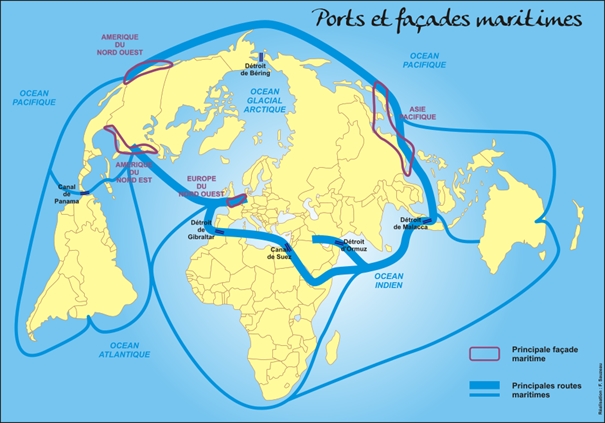
Legal ownership of the seas is based on a specific form of sovereignty. States do not exercise total power over them, but rather specific rights: resource exploitation, control of economic activities, and security surveillance. This functional sovereignty is nonetheless strategic. The EEZ becomes a direct extension of national power. Behind this legal appropriation lies a discreet yet decisive geopolitics. Oil platforms, undersea cables, deep-water ports, and surveillance capabilities form the physical backbone of maritime control. To possess the sea is not to occupy it, but to be able to impose one’s standards and power there and to exploit its riches. International arbitration exists, but its effectiveness depends largely on the willingness of states to comply with it. In several key regions, the law is used as one tool among others. In the South China Sea, the Eastern Mediterranean, or the Arctic, legal claims are accompanied by an increased naval presence. The law thus serves to legitimize fait accompli strategies, revealing the limits of maritime governance based solely on norms and the supposed willingness of states to apply the rules. The law of the sea is now emerging as one of the quiet but essential pillars of global governance. Originally designed to ensure freedom of navigation and prevent conflicts, it now lies at the heart of major strategic rivalries, where issues of sovereignty, security, resource exploitation, and environmental protection intersect. The rise of coastal states, the militarization of certain maritime areas (ports, islands, straits), the expansion of military fleets (a major objective of China, India, and the United States), and the challenges posed by climate change are putting a legal framework based on compromise and multilateralism to the test. The world’s straits are the arteries of global trade. Global commerce depends on a handful of maritime passages that act as chokepoints In this context, the effectiveness of the law of the sea depends less on the soundness of its principles than on the political will of the actors to respect them and adapt them. And this is where the problem lies, for the growing gap between legal norms and state practices highlights the limitations of a maritime order based on consensus, but also reveals its strategic importance: where the law retreats, confrontation advances. Conversely, strengthening mechanisms for cooperation and dispute resolution remains one of the few ways to contain tensions in a maritime space that has become central to the global geopolitical balance. The seas and oceans, while not fully territorialized, are now largely appropriated. In this context, the tension between mare liberum and mare clausum remains as relevant as ever. The oceans are both spaces of global circulation and zones of asserted sovereignty. This ambivalence shapes the maritime geopolitics of the 21st century. The maritime legal order has not eliminated conflicts; it has merely displaced them. Overlapping exclusive economic zones and disagreements over maritime boundaries have become flashpoints of tension. A genuine, accepted, and enforceable maritime order has yet to be established.
The situation in the South China Sea is a prime example of the ineffectiveness of UNCLOS. This sea is crucial for both economic reasons (30% of global trade passes through it, and it is believed to contain significant resources) and geopolitical reasons (control of shipping routes between Asia and the Middle East, and the presence of Taiwan). China currently claims the majority of the area via the “nine-dash line,” a highly contested historical demarcation. Since the 2010s, China has pursued a policy of creating artificial islands (reclaiming reefs and building ports, airstrips, and military bases), particularly in the Paracel and Spratly Islands. These actions are often described as de facto annexations or “fait accompli” annexations. The states in the region, the Philippines, Vietnam, Malaysia, Brunei, and Taiwan, have contested these annexations in the name of the EEZs recognized by UNCLOS, and in 2016, the Permanent Court of Arbitration in The Hague rejected China’s claims; however, China not only rejected the decision but also stated that it did not recognize the Court. Today, China continues these annexations and is now showing interest in the Senkaku/Diaoyu Islands, located not far from Japan, but also from the large U.S. military base in Okinawa. In the Arctic, the rapid melting of sea ice is opening up a strategic arena that was previously difficult to access. The Arctic is no longer an isolated region: it is becoming an arena of rivalry where international law is used as a lever of power. Russia, Canada, Denmark (Greenland), Norway (Svalbard), and the United States (Alaska) are claiming the extension of their continental shelves beyond 200 nautical miles, backing their claims with scientific expeditions and symbolic demonstrations. Furthermore, the interest shown by U.S. authorities in Greenland is part of an overt expansionist strategy. The Arctic illustrates how legal ownership of the seas is never neutral: it serves as a framework for the projection of power, the securing of maritime routes, and access to strategic resources (oil, gas, rare metals), transforming a frozen expanse into a arena of active geopolitical competition. The four pressing contemporary challenges—strategic rivalry among major powers, the shift of the maritime world’s center of gravity toward Asia, the accelerating human impact on the oceans, and environmental threats—make the establishment of a genuine global maritime governance system an urgent priority. Control of sea lanes remains, now more than ever, one of the cornerstones of power. The oceans are also at the heart of an existential ecological challenge for humanity.