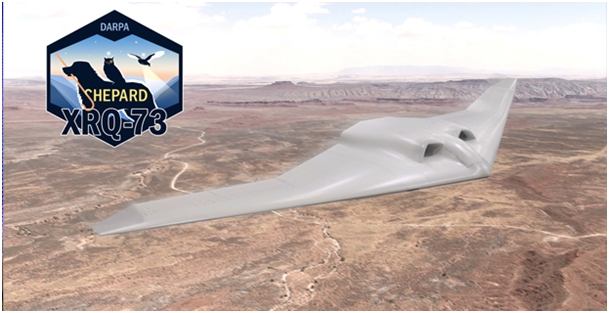
Few month ago DARPA (Defense Advanced Research Projects Agency), the renowned advanced research agency of the US Department of Defense also known for its military technological innovations, unveiled the official designation of its new electric stealth drone, the XRQ-73. DARPA, has unveiled the XRQ-73, a revolutionary drone that succeeds the XRQ-72A. The development program for this drone, called Series Hybrid Electric Propulsion Aircraft Demonstration (SHEPARD), aims to demonstrate the capabilities of a hybrid-electric aircraft. The first flights of the XRQ-73 were carried out at the end of 2024.
The Pentagon’s advanced research and development arm is launching a new effort to fly a quiet spy plane. The XRQ-73 SHEPARD will use a hybrid electrical propulsion system that will eliminate engine noise over enemy territory. Combined with a radar-evading design and a reduced infrared signature, the XRQ-73 SHEPARD could remain undetected over enemy territory and scoop up intelligence without an adversary knowing it was there. The plane is designated XRQ-73: X for experimental plane, R for reconnaissance, and Q for unmanned. It would be the 73rd official X-plane developed by the Department of Defense, a long line of famed aircraft that started in 1946, with the Bell X-1 supersonic jet plane. The plane’s designation gives away its purpose: an unmanned spy plane. The XRQ-73 SHEPHARD name is an acronym, Series Hybrid Electric Propulsion Aircraft Demonstration, and explains what will make the machine special. It will be the first known military aircraft to will do away with jet engines entirely, relying on electricity for propulsion.
According to DARPA, the XRQ-73 will be an unmanned aircraft designed to collect intelligence. Concept art depicts a flying wing design (like the B-21 Raider stealth bomber), the lack of a fuselage, vertical stabilizers, and a cockpit. The drone will be several orders of magnitude smaller than a bomber, however—DARPA says it is a Group 3 drone, a size class that tops out of 1,320 pounds. XRQ-73 will weight 1,250 pounds. Like the B-21 Raider, the XRQ-73 is also being built by Northrop Gruman. First flight is scheduled for sometime this year. On a regular jet aircraft, gas turbine engines suck in and pressurize air, then burn oxygen and jet fuel in a combustion chamber. The engine then pushes the gasses created by the process through the rear of the engine, creating the thrust that propels the aircraft forward. In a hybrid electric propulsion aircraft, engines burn jet fuel to create electrical power. The power is then used to turn fans that create thrust. A hybrid propulsion aircraft can briefly rely on batteries, resulting in a quieter aircraft, a major quality of life improvement for people living near airports. It can use both direct electric power and battery power to temporarily increase power, such as during takeoffs. Engineers have been working on commercial hybrid electric aircraft for years, but a useful, fully operational craft has been elusive thus far.
Smaller, short range flying drones like quadcopters and hexacopters are typically powered by batteries. As drones grow larger, they are expected to have longer ranges and greater payloads, and an internal combustion engine like a prop-driven engine or gas turbine is considered mandatory.
All of that additional power from burning fuel has a price: internal combustion engines are loud. The Shahed-136, a prop-driven kamikaze drone designed by Iran and used by Russia in its war in Ukraine, makes so much noise that it is known as the “flying washing machine.” Ukrainian air defenders can usually hear the Shahed before they can see it, giving them time to man their anti-air defenses and scan the skies. American drones are no exception. The U.S. Army’s RQ-7B Shadow is similarly noisy, producing a sound that resembles one continuous, unending fart. Like the XRQ-73, the RQ-7B is classified by the Pentagon as a Group 3 class drone, a class of drones that typically fly at a maximum altitude of 18,000 feet. A RQ-7B engine produces up to 99 decibels of sound, which at 18,000 feet would be reduced to 13 decibels. That’s the noise equivalent of a human being breathing, meaning that hearing a RQ-7 at three miles up is certainly possible. Unlike civilian hybrid electric aircraft, military aircraft would use electric power differently. A plane like the XQR-73 would take off and land with the engine providing electrical power to the fans. As it nears enemy territory, the aircraft would switch off the gas turbine and power the fans from batteries. The drone’s engine noise disappears, and the plane is suddenly flying silent.
XQR-73 is a direct descendant of Great Horned Owl (GHO), another project to develop a quiet unmanned aerial vehicle. GHO was a project of the Intelligence Advanced Research Projects Activity (IARPA), DARPA’s equivalent in the intelligence community. The name is a reference to the ability of owls to fly silently, undetected by their prey.
It’s not clear whatever happened to Great Horned Owl. A 2011 PowerPoint presentation outlines the same key objectives of the XQR-73 program, so it’s possible that GHO was eventually deemed technically unachiveable at the time. The two aircraft programs rely on battery technology to succeed, a field that has seen remarkable progress in the last 13 years. So, perhaps DARPA thinks the tech has advanced to a point where silently flying a 1,250 pound drone is possible.
Great Horned Owl was also a Northrop Grumman Project, so some of the design will likely carry over to the XQR-73. One area where the two planes differ is the placement of the fans, GHO features four fans mounted above the aircraft, while the XQR-73 buries them inside the body of the aircraft. Burying the fans eliminates their radar signature, making the aircraft harder to detect. Hybrid electric aircraft have the potential to revolutionize the aviation industry. A successful XQR-73 will be a groundbreaking aircraft, ushering in an era of quieter flight. Good news for people living in the flight path of airports.