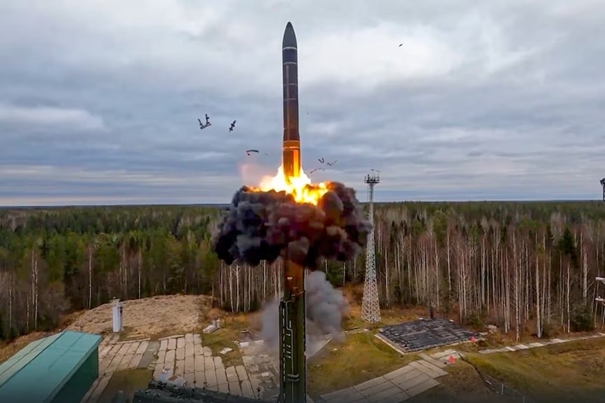
The Oreshnik missile, unveiled by Russia in late 2024, is described as an intermediate-range ballistic missile designed to strengthen Russia’s strategic posture, though it does not represent a major technological breakthrough. Derived from earlier programs such as the RS-26 Rubezh, it appears to be based on the adaptation of existing technologies, with announced terminal maneuvering capabilities and the ability to carry conventional or nuclear warheads. Beyond its actual performance, the Oreshnik is primarily intended as a deterrent and a political signal, with Moscow exploiting the end of the INF Treaty to reaffirm its strike capability and maintain strategic ambiguity toward Europe and the Middle East.
The Oreshnik missile, known in Russian as Orechnik (“hazel tree”), is a ballistic missile whose existence was made public by Russia in late 2024. From the moment it was unveiled, Oreshnik was described by Russian authorities as a weapon capable of altering the regional—and even continental—strategic balance. According to information released by Moscow, the missile is the result of an accelerated development effort based on earlier ballistic programs. Several analysts believe it is a continuation of projects such as the RS-26 Rubezh, an intermediate-range missile whose development had been suspended before being quietly redirected. This connection suggests that, rather than a technological breakthrough, the Oreshnik is an adaptation of existing technologies, modernized to meet new strategic and doctrinal needs. To date, many questions remain unanswered regarding this missile, but it seems reasonable to assume that it is a direct derivative of the RS-26, a “shortened” version of the RS-24 intercontinental ballistic missile. Is it simply an RS-26 equipped with conventional warheads? An adaptation of the existing model? Or a new development based on the RS-26? These questions remain unanswered. However, it seems unlikely that Russia designed this missile from scratch, especially since it already had a missile with characteristics close to what was required.
Officially classified as an intercontinental ballistic missile (ICBM) due to its maximum range exceeding 5,500 km, the RS-26 nevertheless appears to belong more to the category of intermediate-range missiles. However, this category was prohibited for Russia under the Intermediate-Range Nuclear Forces (INF) Treaty. This treaty, which was withdrawn from by the U.S. and Russia in February 2019, is no longer in force, thus allowing Russia to explore new strategic options. Furthermore, it is important to note that a missile designed for intercontinental ranges can certainly be used over much shorter distances, thereby adapting its use to the operational needs of the moment. Hypersonic weapons travel over Mach 5 and can maneuver mid-flight, making them extremely hard to intercept. There is two main types: hypersonic Glide Vehicles (HGVs): boosted before gliding unpredictably and hypersonic Cruise Missiles: scramjet-powered for sustained, fast flight. Their speed and maneuverability leave defenders little time to track or react.
The Oreshnik missile is a medium-range ballistic missile with hypersonic warheads with a range of up to 5,500 km, can reach speeds of Mach 10, with multiple warheads for increased strike capability. It is designed to strike hardened targets, and can penetrate 3–4 layers of reinforced concrete. But from a technical standpoint, the exact specifications of the missile remain largely classified. Available estimates suggest it is a land-based intermediate-range ballistic missile capable of striking targets located several thousand kilometers away. It could carry either a conventional or a nuclear warhead, which heightens its strategic ambiguity. Russian authorities claim that the Oreshnik missile is capable of performing terminal-phase maneuvers to make it harder for modern missile defense systems to intercept it, a central argument in official communications regarding this program. Beyond its actual military capabilities, the Oreshnik missile plays an important role in Russia’s deterrence strategy. Since the expiration of the INF Treaty, which banned ground-launched missiles with ranges between 500 and 5,500 kilometers, both Russia and the United States have regained complete freedom in this area. The announcement of the Oreshnik can thus be interpreted as a way of reminding the world that Moscow retains the capability to strike strategic targets in Europe or the Middle East rapidly, while deliberately maintaining uncertainty regarding the exact nature of the weapon and its potential operational deployment.
Originally intended for nuclear deterrence, this type of missile has been used in a completely different context. During the attack on the Pivdenmach factory in Dnipro, it was equipped with six warheads, each containing six inert submunitions. The ballistic missiles fired by Russian forces at the city did not carry the six MIRVs—independent reentry vehicles each armed with a 150-kiloton nuclear warhead—but rather vehicles armed with conventional warheads. This marks the first use of such a missile with submunitions, representing a significant shift in its tactical application. Based on the known characteristics of the RS-26 missile, it can be estimated that each submunition weighs between 30 and 35 kg, in order to comply with the maximum authorized payload for this type of projectile.
President Vladimir Putin took the opportunity to point out that this nuclear-capable tactical missile was four times more powerful than the Hiroshima bomb. He also noted that Europe lacked early-warning systems and would be the first to be obliterated in the event of an escalation of the conflict. Nothing new in hypersonic technology – It is worth noting that France’s M51 strategic nuclear ballistic missile can reach Mach 15, enabling it to cross the Atlantic in less than 15 minutes. It is also worth noting that all Russian intercontinental missiles have been capable of reaching this high velocity for decades and are theoretically capable of reaching Paris in about twenty minutes. This hypersonic speed is therefore nothing new, and the entire nuclear arsenals of countries possessing this type of weaponry have this capability. Is the missile impossible to intercept? Just as much as all nuclear ballistic missiles were during the Cold War and still are today. Such a missile, whether intercontinental or intermediate-range, like the Oreshnik, follows a ballistic trajectory. It climbs into space to over a hundred kilometers, sheds its nose cone, and releases several warheads that will fall back to Earth at very high speeds. The law of gravity does its work, but there is no real possibility for maneuvering precisely because of this high speed. In the case of the Oreshnik, six warheads were counted. The practice of encapsulating multiple warheads to strike as many different targets is called MIRVing. Virtually all current nuclear ballistic missiles are MIRVed. The French M51, for example, is equipped with more than six nuclear warheads (the exact number is unknown). In any case, the interception window for such a missile is very narrow. A few seconds at most. So, if there are multiple simultaneous arrivals, the interceptors will struggle to neutralize them all. This is therefore nothing new, and this entire deadly arsenal is not meant to be used anyway. In any case, everyone would lose out in the end. Many Western experts believe this is a shortened version of the Yars intercontinental ballistic missile (ICBM), without its third stage. This is what is known as an IRBM, an intermediate-range missile with a range of 2,000 to 5,500 kilometers, and such missiles have existed for decades. So, nothing particularly new here. As for its components, several images of the debris show that they are based on technologies dating back as far as the 1950s or 1960s. Note that this does not mean it is obsolete or ineffective; since it works properly, there is no reason to do things differently. In any case, one thing is certain: the Oreshnik is nothing revolutionary; it is a “small” ICBM. Similarly, like most Russian delivery systems, it can easily be equipped with nuclear warheads. Concerns should therefore apply equally to the entire Russian arsenal, but this is not the case. What remains concerning is that Russia, like other countries—such as those in the Middle East—is using this family of ballistic missiles for long-range conventional strikes. This remains below the threshold of a nuclear attack, of course, but it involves the same type of launchers.
For now, the Oreshnik arsenal is likely limited, but that could well change within a few years. In any case, it is highly significant. The other concern is that, in the face of this threat, European countries do not possess equivalent systems. Projects have certainly been launched, but they are far from completion. Yet the use of conventional IRBMs could prove devastating to critical infrastructure (airports, military bases, energy or industrial facilities…). As President Vladimir Putin pointed out in a threatening tone in 2024, during the first test launch of the Oreshnik, European countries—and France in particular—do not, in fact, have an early warning system. For France, this is a deliberate choice, since the country possesses nuclear weapons. It is precisely against nuclear ICBM strikes that France’s M51 missiles would be launched in retaliation. In this scenario, even with early warning systems and interceptors, such as those of Russia or the United States, a massive strike by the entire French nuclear arsenal would obliterate most of the country’s strategic nerve centers. In other words, the first to fire would gain nothing. That is the whole point of deterrence. On the other hand, this deterrence obviously cannot work against equivalent missile strikes armed with conventional warheads. And just like their nuclear counterparts, they would be difficult to neutralize. Moreover, as for their potential interception, only Germany possesses an Israeli Arrow 3 ballistic missile defense system. This system would not be sufficient, in any case, to destroy multiple launches of conventional IRBMs or ICBMs.
Without exaggerating their power, the use of this type of weapon should not be taken lightly. For now, these Russian threats are primarily being used to send a message and intimidate the people of Europe. And the underlying message remains the same: to demonstrate that Russia is invincible and that it is best not to stand in the way of its efforts to reclaim its geopolitical sphere of influence. In Washington, the Trump administration is responding, but it’s mixing up strategies and rhetoric. The U.S. response announced by Trump—which includes the resumption of nuclear tests—creates a confusion that lumps together delivery system tests and warhead detonations. Here again, impact matters more than precision: the idea is to make it clear that the United States does not intend to remain in the “restraint” camp if others raise the stakes. The problem is that every word sets off a chain reaction: if one side talks about detonations, the other promises to respond; and, in the meantime, the psychological threshold of “we don’t do that anymore” is lowered. Especially since, on February 5, 2026, the New START treaty expired, marking the end of the last symbolic bulwark limiting strategic warheads. Moscow is proposing a short, conditional extension; Washington is evaluating the offer but is already thinking in terms of modernization. And this is where economic scenarios come into play: this is not just a missile race, it is a spending race. In the United States, the estimated costs for renewing and maintaining the arsenal over the next decade are becoming a structural fixture: money, industries, contracts, consensus. In Russia, rearmament is also a demonstration of technological resilience and the ability to sustain highly complex industrial sectors despite sanctions and isolation. Since the treaty has not been renewed, the most likely consequence is not an immediate increase in the number of warheads, but rather greater uncertainty: more patrols, more alerts, and more investment in surveillance, air defense, anti-submarine warfare, and space.
Europe is the weak link: closer, more exposed, and under greater pressure to spend in order to fill gaps that are now becoming painfully apparent. And China is watching and growing in power. The United States would like broader agreements, but Beijing has no interest in allowing itself to be boxed in while it is on the rise. In short, the Oreshnik missile works even if it is rarely used: it is enough that it forces others to rethink radars, flight paths, reaction times, and, above all, budgets. Deterrence in the 21st century resembles less and less a balance and more and more an operating account: whoever bears the expense maintains order. Whoever does not bear it discovers that instability is no accident; it is the new price of security. Russia uses hypersonic missiles selectively—for highly valued targets and hardened infrastructure, they are used along with conventional missiles and drones to provide speed and unpredictability. Beyond their military role, hypersonics may also have psychological value, deterring by signaling the ability to strike quickly and deeply. Russia has also built a defensive missile system, the S-500, capable of countering hypersonic threats
Military history teaches us that any offensive advantage is eventually countered by a defensive innovation. Intercepting a hypersonic missile is arguably the most daunting technical challenge ever posed. First, the vehicle must be detected, which is made difficult by its low-altitude flight and potentially reduced radar signature. Second, the reaction time is extremely short—on the order of a minute or less. Finally, an interceptor must be launched on a collision course with a target maneuvering at several kilometers per second. Yet defenses are evolving. Space-based radars, exo- and endo-atmospheric interceptors such as THAAD, SM-3, or Patriot, artificial intelligence for trajectory calculation, and next-generation lasers are all avenues being explored. The proof was demonstrated in Ukraine: a Patriot system, though designed to counter ballistic missiles, successfully intercepted a Kinzhal. This major event proves that no weapon can guarantee a 100% breakthrough of a modern shield, and that the race, far from being over, is entering a new phase. The battle between hypersonic weapons and missile defense systems is far from over; on the contrary, it is entering a new phase, in which technological innovation, electronic warfare, and the proliferation of sensors will determine which side prevails. These weapons are as fascinating as they are alarming, and their development will continue to reshape the global geopolitical balance for decades to come.