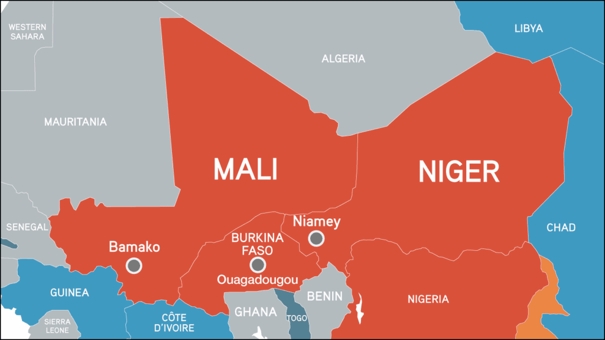
In 2026, Mali faces rising JNIM attacks, blockades in Bamako. Following Malian President Assimi Goita’s seizure of power in 2021, Mali embarked on a strategic transformation by expelling French and U.N. forces from the country. Although this shift was widely considered risky given the region’s fragile security architecture, the Malian government has sought to reshape the regional security paradigm through new partnerships. In this context, Mali has continued its fight against terrorist organizations by engaging in security-based cooperation with countries such as Russia, China and Türkiye. Mali is sinking deeper into chaos. In a series of attacks unprecedented in scale launched on Saturday, April 25, jihadists from JNIM (Group for the Support of Islam and Muslims)[1] and Tuareg rebels from the FLA (Azawad Liberation Front)[2] targeted the positions of the ruling junta in several major cities across the country, now threatening the capital, Bamako. Among the victims of these attacks is Defense Minister Sadio Camara. The death of one of the regime’s key figures underscores the weakening of a military junta that seized power by force in 2020, promising, among other things, to put an end to such violence.
After seizing power following a series of coups (in the summer of 2020 and then in the spring of 2021), the military junta justified its actions by citing the authorities’ inability to defeat the terrorist violence that had plagued the country for many years. Assimi Goïta, Mali’s new strongman, then advocated a program to reclaim lost territories. His strategy involved breaking ties with the state’s traditional allies, including French forces, which had been called in by Bamako in 2013 and were forced to leave the country nearly a decade later. Rejecting Operation Barkhane, the Malian government chose instead to rely, starting in 2022, on Russian mercenaries from Wagner, and later on the Africa Corps, a paramilitary organization directly controlled by Moscow. The military has had some successes to its credit, particularly in 2023, with the recapture of Kidal, a city that had long been held by Tuareg rebels from Azawad (a region encompassing the north of the country). However, setbacks have mounted, from the jihadist blockade of Timbuktu to the fuel crisis caused by the actions of JNIM. The junta’s weakening is exacerbated by the Africa Corps’ ongoing withdrawal from parts of the north of the country. Like Wagner, which it replaced in 2025, the Russian paramilitary group has never managed to resolve the country’s security issues, despite numerous military operations, particularly when facing groups already well-versed in asymmetric warfare.
Long considered a priority sphere of influence for France, the Sahel has, in just a few years, become a key battleground for information warfare. France’s loss of influence, the successive coups d’état in Mali, Burkina Faso, and Niger, and the arrival of new foreign actors have profoundly reshaped the region’s media and geopolitical landscape. The most recent assessments of terrorist violence[3] around the world point to a conclusion that is now hard to ignore: the epicenter of terrorism has shifted to the Sahel and, more broadly, to sub-Saharan Africa. If we consider the overall impact of attacks—and especially the death toll they cause—as the primary criteria, this region now appears to be the main hotbed of terrorist violence on a global scale. This shift represents a major departure from the previous two decades, during which the Middle East and North Africa occupied a central place in strategic assessments of the phenomenon. Global terrorism no longer follows the same patterns as it did at the beginning of the 21st century, and a significant portion of its lethality is now concentrated in the Sahel region. The Sahelian juntas emerged from a genuine popular demand for security and sovereignty, but five years later, the security and humanitarian situation in Mali, Burkina Faso, and Niger has deteriorated dramatically, with a surge in violence, civilian casualties, and population displacement. Despite the breakdown in relations with Western partners, the rise of the Alliance of Sahelian States, and the replacement of the French presence with Russian cooperation, jihadist groups have grown stronger, exploiting local abuses and the lack of political responses to social divisions.
The initial legitimacy of the military regimes is eroding as results fail to materialize, revealing the impasse of a strategy focused exclusively on security that is incapable of rebuilding the social contract and addressing the root causes of instability in a sustainable manner. More than five years have passed since August 18, 2020, when Colonel Assimi Goïta overthrew Ibrahim Boubacar Keïta in Bamako. That initial coup set in motion a cycle that would sweep through Burkina Faso and then Niger, giving rise to the Alliance of Sahel States. A break with Paris, an alignment with Russia, and a dramatic withdrawal from ECOWAS: the geopolitical transformation has been spectacular. But what about concrete results for the people? From his exile in Algiers, Mahmoud Dicko broke his silence in December 2025 by launching the Coalition of Forces for the Republic (CFR), calling for civil, ethical, and judicial resistance against General Assimi Goïta’s junta. At the time, bolstered by his religious legitimacy—which had been highlighted following the fall of Ibrahim Boubacar Keïta in 2020—the imam had established himself as a figure capable of uniting political opponents, civil society, and advocates for dialogue with armed groups. But today’s context is different, in a Mali now suffocated by insecurity and economic crisis. And the situation that prevailed at the time has changed. We must now place our hopes in the new political generation, which is emerging despite the circumstances in Mali. Besieged by JNIM and unable to address the country’s security challenges, the Malian regime is weakened, and its fragility threatens the entire Alliance of Sahel States, an alliance created to consolidate the power of the juntas. According to Abdallah Ben Hamallah, a nephew of the most influential religious leader in Mali, Mohammedou Ould Sheikhna Hamahoullah, believes that as a landlocked country, “Mali needs to work with its neighbors to stop the flow of weapons getting to the armed groups inside the country. The most important one is by and large Algeria who has the means to put an end to all this.” He also points out that: “Algeria is not only the biggest neighbor of Mali in terms of area, but also shares a border of more than 1,300 km with Mali, and is the most influential country militarily, economically, and geopolitically, that neighbors Mali. Consequently, it has the biggest role to play for there to be lasting peace in Mali,” And he further affirmed that “ultimately, it will have to be Malians who defend their land, not foreigners.”
Consequently, jihadist groups are thriving. Iyad Ag Ghali’s JNIM is now believed to have between 5,000 and 7,000 fighters—up from 3,000 to 4,000 in 2020. The organization has successfully exploited the resentment generated by abuses attributed to the armed forces and their auxiliaries to strengthen its foothold in communities. The ambush at Tin Zaouatine in July 2024 claimed the lives of dozens of Malian soldiers and Wagner fighters. The insurgents’ capacity to cause harm remains intact, if not strengthened. And then there are the displaced, these silent victims. 2.1 million in January 2021. 4.8 million in December 2024. Burkina Faso alone has 2.3 million. Furthermore, the number of areas inaccessible to humanitarian aid workers was twelve in 2021; it is now estimated at forty-seven. OCHA estimates that 9.4 million people are facing severe food insecurity across the three countries. Four years ago, that number was 5.8 million. Behind these statistics, entire families are fleeing abandoned villages, resulting in shattered lives and growing insecurity.
In this context, there is a paradox of legitimacy. How do these regimes manage to hold on in these Sahelian regions despite everything? Polls in the early months showed approval ratings above 70%. A visceral rejection of corrupt civilian elites, hope for tangible improvement: the initial legitimacy was real. But it is eroding inexorably. It depends on results that are slow in coming. Power therefore relies increasingly on the traditional instruments of domination: control of the coercive apparatus, a stranglehold on the media, and nationalist mobilization against external “enemies.” For example, iIn Burkina Faso, military spending has risen from 4.2% of GDP in 2021 to nearly 7% in 2024. More than 50,000 Volunteers for the Defense of the Fatherland (VDP) have been armed. With the well-documented risks we are familiar with: communal score-settling, the emergence of local warlords, and highly problematic future disarmament. The fall of Captain Sankara in 1987, the overthrow of Damiba after barely eight months: West African history reminds us that military rule can collapse just as quickly as it took hold.
Five years later, one lesson stands out clearly: security-only approaches, whether they come from Paris or Moscow, do not resolve crises whose roots are fundamentally political. The marginalization of peripheral regions, the exclusion of entire communities, the collapse of public services, and endemic corruption—neither Barkhane yesterday nor Africa Corps today can address these structural ills. Replacing one form of dependence with another is not a sustainable solution. The future of the Sahel will be decided less in military headquarters than in the ability of these societies to rebuild an inclusive social contract. Will the armed forces—now politically dominant but structurally weakened by the erosion of their legitimacy—be the drivers or the obstacles of this essential rebuilding? The answer will determine the fate of populations whose demand for protection—the very demand that brought the coup leaders to power—remains, five years later, tragically unmet.
In Mali, Colonel Assimi Goïta has been leading the country since May 2021. According to the 2026 Global Terrorism Index, the country has indeed seen a decline in terrorism-related deaths for the third consecutive year—a 42% drop in 2025. However, this figure should be interpreted with caution. The decline in violence statistics is not the result of a military victory, but partly the result of tacit agreements with the warring parties. In March 2026, Bamako quietly released several dozen prisoners affiliated with GSIM in exchange for a cessation of attacks on fuel convoys bound for the capital—convoys that Iyad Ag Ghali’s armed group had begun targeting in September 2025 to cripple Mali’s economy. Goïta’s junta firmly denied this agreement, fearing it would be interpreted as an admission of weakness. Yet it was precisely this same model that Tchiani is now seeking to replicate in Niger.
In the area of human rights, the Malian armed forces and the Russian paramilitary group Africa Corps—formerly Wagner—continue to summarily execute civilians of the Fulani ethnic group, who are being ethnically targeted due to persistent conflation with jihadist fighters. Journalists, activists, and figures critical of the junta are arbitrarily detained, subjected to enforced disappearances, or illegally conscripted into the military. Mali’s civic space has been reduced to a shadow of its former self. Political parties no longer have a place in a country that has formally recommended banning the multiparty system for the duration of its transition. Last April, jihadists, allied with Tuareg separatists, launched unprecedented coordinated attacks against the ruling junta on Saturday. The fighting continued for several days near the capital, Bamako, and in the north of the country, in the Sahel region. The defense minister Sadio Camara was among the victims of these attacks. The fighting pits the Malian Armed Forces (FAMa), supported by mercenaries from the Russian paramilitary organization Africa Corps, against jihadists from the Group for the Support of Islam and Muslims (JNIM), affiliated with Al-Qaeda. Active for several years in the center and north of the country, this jihadist group has been waging an insurgency against the Malian state and has notably stepped up attacks on military positions. For these attacks, the JNIM jihadists have allied themselves with the Malian Tuareg rebels of the Azawad Liberation Front (FLA). This separatist group was formed in November 2024, following the dissolution of a coalition of armed independence groups. It claims the territory of Azawad in the north of the country. The group lost control of several towns in late 2023 following an offensive by the Malian army and Russian mercenaries, which notably led to the capture of Kidal. Mali has been plagued by conflict and jihadist violence for more than a decade, but since the junta seized power in 2020, attacks by jihadists and Tuareg rebels have reached unprecedented levels. After fighting resumed last April, the Tuareg rebels announced that they had reached an “agreement” allowing Russian paramilitaries to withdraw from the town of Kidal, which they say they ‘now’ control “entirely.” “An agreement was reached to allow the army and its Africa Corps allies to leave Camp 2, where they had been entrenched since yesterday,” a Tuareg rebel official told AFP the day before. The FLA had also claimed to have taken control of several positions in the Gao region, in the north of the country.
The international community has condemned these attacks. After fighting broke out in the country, international reactions were swift. The Economic Community of West African States (ECOWAS), of which Mali has not been a member since January 2025, also responded on X, condemning the previous day’s attacks. “These heinous acts demonstrate once again the barbaric nature of the perpetrators, who continue to threaten peace, security, and stability throughout (…) West Africa,” it stated. The Chairperson of the African Union Commission, Mahamoud Ali Youssouf, strongly condemns these acts, “which risk exposing civilian populations to significant danger.” UN Secretary-General António Guterres also condemned “violent extremism” following these attacks and called for “coordinated international support to address the evolving threat of violent extremism and terrorism in the Sahel and to respond to urgent humanitarian needs” in a statement. The European Union also “strongly condemned the terrorist attacks” and expressed its solidarity with the Malian people in a statement released at the time by the office of its High Representative for Foreign Affairs, Kaja Kallas. “We reaffirm our determination in the fight against terrorism, as well as our commitment to peace, security, and stability in Mali and throughout the Sahel,” the EU stated. A historically nomadic people spread across several countries—Mali, Niger, Algeria, Libya, and Burkina Faso—the Tuareg have been waging armed struggles for decades against their “marginalization,” particularly around Kidal, where in 2012 they allied with jihadists led by Iyad Ag Ghali, then leader of Ansar Dine, to seize major cities in the north, before splitting from them following clashes, with the jihadists subsequently driving out the separatists. The two sides have grown closer in recent months following a meeting of their leaders to join forces against the Malian junta. The Tuareg rebels maintain close ties with the jihadists, embodied by Iyad Ag Ghali, himself a former Tuareg rebel leader in the 1990s who became the founder and leader of JNIM (Group for the Support of Islam and Muslims, affiliated with Al-Qaeda) in 2017.
Mali is currently facing a serious security crisis; this vast Sahelian country has been plagued by jihadist conflicts and violence since 2012. What might happen now? Three scenarios are possible. Scenario One: The junta holds on. Thanks to Nigerien aid—by late 2025, 82 fuel tankers escorted by the Nigerien army had reached Bamako—and reinforcements from Russian mercenaries of the Africa Corps, Goïta loosens the noose. The CFR remains confined to exile, unable to mobilize. This scenario assumes that the regime retains the capacity to project power beyond Bamako amid economic suffocation, deprivation, and the erosion of its authority.
Second scenario: the fracture. The situation continues to deteriorate, discontent grows, and cracks in the military apparatus become increasingly evident. Calls for ethical disobedience resonate with demoralized officers. An internal coup overthrows Goïta and paves the way for a negotiated transition—perhaps involving talks with armed groups. This scenario would replicate, in fast-forward, the sequence of events from 2020.
Third scenario: implosion. No credible alternative, no orderly transition. JNIM consolidates its hold on rural areas and its pressure on the suburbs. Mali descends into a “failed state” scenario, with a besieged capital and a hinterland under de facto jihadist governance. This scenario, the bleakest, is not the least likely. Despite the intensification of “counterterrorism operations,” jihadists and their Tuareg allies are expanding their territorial control. As a key player in any political solution, Algeria is determined to regain its influence in the region.
For fourteen years now, Mali has been plagued by deadly and destabilizing jihadist attacks. The Algiers peace accords, signed in 2015 but never fully implemented, were denounced by Bamako in 2024. Despite several foreign interventions mobilizing thousands of soldiers—Chad from the very first attacks by the Islamist armed group Ansar Dine and the National Movement for the Liberation of Azawad in 2012, France between 2013 and 2022 through Operations “Serval” and “Barkhane,” the United Nations Multidimensional Integrated Stabilization Mission in Mali (MINUSMA) between 2013 and 2023, and the G5 Sahel joint force (Burkina Faso, Mali, Mauritania, Niger, Chad) supported by Paris—the north and center of the country are, directly or indirectly, controlled by the rebels. The Malian Armed Forces (FAMA) have failed to regain lasting control of the territory and prevent the massacres of civilians (thousands of deaths per year since 2021). Worse still, jihadists from the Group for the Support of Islam and Muslims (GSIM, affiliated with Al-Qaeda), now allied with the Tuareg separatists of the Azawad Liberation Front (FLA), have been encircling the capital, Bamako, since the fall of 2025, causing shortages and insecurity. Surrounding General Assimi Goïta, who is in power for a five-year “transition,” the military officers behind two coups in 2020 and 2021 insist that these dramatic events are merely hiccups that do not undermine their strategy for regaining control, which they present as “sovereignist.” It is based on the rejection of cooperation with France, deemed ineffective and neocolonialist. Against this backdrop of regional tensions involving foreign powers and following France’s withdrawal from Mali, the situation does not appear to be stabilizing. But the setbacks suffered by the Bamako junta at the hands of insurgent groups have restored Algiers to a position of mediator after years of waning influence in the region.
The ongoing political and military upheaval in Mali also marks a turning point in regional geopolitics. The territorial gains made last April by jihadist and separatist insurgent groups in northern Mali against a Bamako army now on the defensive are effectively reshaping the balance of power in the Sahel-Saharan region by bringing one country back into the picture: Algeria. Algeria had seen its influence wane since late 2023 in its southern border regions as its relationship soured with the Malian junta and, consequently, with the coup leaders in Niger and Burkina Faso, who stood united within the Alliance of Sahel States. Contacts between Mali and Algeria had virtually broken down, with Mali denouncing Algeria’s calls for dialogue with the Tuareg and Arab armed groups in Azawad (in the north of the country) as “support for terrorism.” Since then, the situation has returned to normal with Niger and Burkina Faso. At the time, the FAMa—the Malian Armed Forces—bolstered by support from Wagner Group contingents (later replaced by Africa Corps), had launched a military campaign to retake northern Mali, disregarding the political talks advocated by Algiers. This phase of Algeria’s ouster from the Malian political scene appears to be coming to an end, at least in part. For recent events have restored the great northern neighbor to the role of mediator that had historically been its own. Its successful good-offices missions to broker agreements regarding various Tuareg uprisings (1991 and 2006 in Mali, 1997 in Niger) had cemented its role as a regional sponsor—a role that Algeria can continue to play in the Malian crisis. Algeria could therefore make a significant contribution to this issue if relations with Mali were not so strained; the country has years of experience in counterterrorism and, given its extensive track record in this area, has effectively mastered the dynamics of the separatist and extremist groups active in the Sahel.
——————————————
[1] Founded in Mali in 2017, Jama’at Nusrat al-Islam wal-Muslimin (JNIM) is now the leading jihadist group in the central Sahel. Since 2019, violence perpetrated by this al-Qaeda affiliate has spread to several countries in the Gulf of Guinea, targeting Côte d’Ivoire, Benin, and Togo.
[2] The Azawad Liberation Front (FLA) is a political and military organization in northern Mali founded on November 30, 2024. It was formed following the dissolution of the Permanent Strategic Framework—which included the National Movement for the Liberation of Azawad (MNLA), the High Council for the Unity of Azawad (HCUA), and parts of the Arab Movement of Azawad (MAA) and the Imghad Tuareg Self-Defense Group and Allies (GATIA)—this movement advocates for the independence or autonomy of Azawad.
[3] Institute for Economics & Peace. Global Terrorism Index 2026: « Measuring the impact of terrorism », Sydney, March 2026. Available from: http://visionofhumanity.org/resources (accessed Date Month Year).